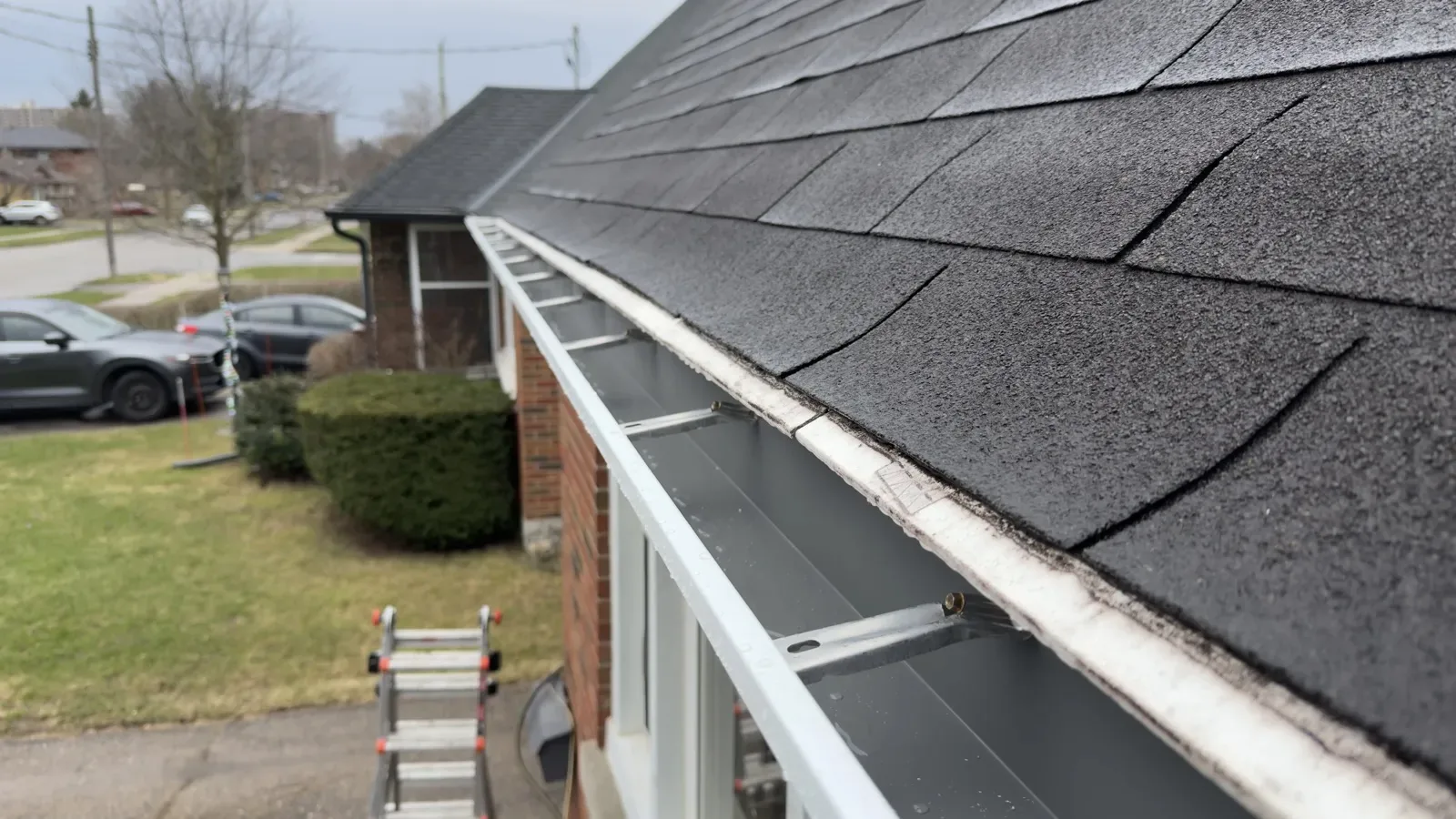
Verify the business, crew and access plan
Confirm the legal contracting name, responsible contact and who will perform the work. Request actual coverage documents and clarify the work they apply to. Ask how upper-storey access and nearby power lines or tight side yards will be managed.
Check WSIB applicability for the particular contract; resident-hired home renovation exceptions exist. Do not infer full liability protection from a certificate or assume every exterior trade has the same licensing requirement.
Ask how the drainage layout was chosen
Ask which roof areas feed each gutter run, where valleys concentrate water and how many outlets are proposed. Have the installer explain the gutter profile, outlet size, downspouts and discharge points together. A larger trough with a restricted outlet may leave the bottleneck unchanged.
Ask how the drainage fall will be set and verified, what the hangers attach to, and what happens if the fascia is soft. Identify connections to existing underground drains before agreeing to reuse or alter them. Local discharge rules still apply.
Compare the complete specification
Quotes should identify gutter lengths, profile and size, metal thickness with units, hanger product and spacing, downspout count and outlet locations. Include old-system removal, supporting repairs, access and disposal.
Continuous runs reduce intermediate joints but still have ends, corners and outlets requiring detailing. Ask how those joints and any movement provisions are handled. Product-specific requirements are more useful than insisting on one thickness or fastener type for every roof.
Check references and warranty scope
Ask references about recurring overflow, leaks and how callbacks were handled. Comparable roof geometry and access are useful context; a new installation photograph does not establish long-term drainage performance.
Get workmanship and product terms separately. Clarify responsibility for leaks, blocked outlets, damaged backing and maintenance. Do not assume a market-standard duration or transferable coverage. Review discharge and visible joints at completion from a safe position.
Questions to close before hiring
- Must I choose six-inch gutters?
- Ask for the reason based on the actual roof, outlets and flow concentration rather than the house style alone.
- Are seamless gutters leak-proof?
- No. Their remaining joints, outlets, supports and maintenance still matter.
- Can a new system use the old downspout discharge?
- Confirm its condition, capacity and compliance with local drainage requirements before assuming it can remain.
Technical references
- Gentek aluminum soffit, fascia and rainware installation guide — Hangers, slope, joints and outlets have product-specific requirements.
- City of Waterloo: Property standards and drainage — Roof drainage must respect neighbouring properties and public routes.
- WSIB: Questions and answers about clearances — Clearance requirements have home-renovation exceptions.

Include a preferred date and time
Discuss your exterior project
Select the exterior work and note the current material and repair or replacement needs.
Prefer to send the details first? Request a quote or call (519) 501-5003.