Interlocking pavers can form a path, patio or driveway with a coordinated pattern and defined edges. The layout should suit how the area is used, not just how the individual unit looks in a sample.
The base is part of the paving
Uneven units and recurring settlement can reflect conditions below the surface. Lifting and relaying a section may involve correcting its support rather than simply placing the same stones back down.
Edges and water movement
Borders help define the shape, while adjoining levels affect how the area meets steps, lawns and entrances. Drainage needs to be considered with those transitions so the new surface does not simply reproduce an old low spot.
Reuse or a new layout?
Existing units may be reusable in a repair, depending on their condition and the intended finish. A quote can separate base preparation, new materials and relaying work.
Define the work
Items to discuss and define in the accepted quotation or management agreement; not automatic inclusions.
Paving layout
Discuss paths, patios or driveways through their intended use, pattern, borders and transitions to entrances or landscaping.
Preparation and repairs
Identify lifting, reuse, new units, base correction, edge restraint and joint work separately, with drainage questions included in the review.
Options to consider
Lift and relay suitable units
Reuse may be possible where the pavers remain suitable; the supporting work still needs to address why the area settled.
Create a new paved area
Select units, pattern and borders together with the planned levels, access and use of the space.
Location planning and service coverage
Interlock Installation and Repair: location planning
Choose a location page for property planning details, related services and an enquiry route. Confirm the property address, requested scope and availability directly before arranging work.
In our clients’ words
What our clients say
Client feedback
Concrete & interlock
★★★★★5 out of 5 stars
"Interlock driveway and front pathway installed this spring. The base prep was thorough — they excavated deep, compacted the granular base in lifts, and the result is level and stable after a full winter."
"We had a large backyard patio done in natural stone interlock. D&D's design suggestions were spot-on and the installation is impeccable. We've had so many compliments from neighbours."
"Had to reset a section of existing interlock that had heaved. D&D re-levelled and re-sanded properly — you can't tell where the repair is. Quick turnaround too."
Agree how the finished area meets steps, lawns and thresholds, with unresolved drainage issues assessed before the layout is final.
Before the assessment
Show the problem area
Photograph uneven sections and standing water, plus the surrounding pavement and building edges.
Identify spare units
Note whether matching materials are available and which existing sections must remain.
Explain intended use
Distinguish pedestrian areas from places used by vehicles or heavier equipment, and identify where those uses cross.
Quick request checklist
Prepare Your Request
Prepare for Interlock Installation and Repair
1
Define the Paving Area
List intended use, layout and existing surfaces.
2
Record Visible Issues
Note movement, damaged edges and water-collection concerns.
3
Compare Specifications
Review paving units, borders, preparation and adjoining details.
4
Confirm Site Arrangements
Clarify access, removal, disposal and any unresolved questions.
Questions about Interlock Installation and Repair
Can sunken pavers be lifted and reused?
Their condition and the reason for settlement need assessment. A relay should describe the supporting correction and matching limits, rather than simply returning the same units to the same unresolved base.
Is new joint sand enough to fix movement?
Joint work and correction of an unstable or settled area are different tasks. Ask what has caused the movement and which parts of the paving assembly the proposed repair actually addresses.
Why are borders and edges part of the quote?
Edge restraint helps hold the paving arrangement in place. The chosen border also affects appearance, but decorative edging alone should not be assumed to describe the required restraint for the installation. CMHA: edge restraints for interlocking paving
Can interlock repair solve a puddle beside the house?
It depends on the connected levels and drainage route. Describe when water collects and have the cause assessed; replacing surface units alone does not establish that water will leave the area as intended.
Will new pavers match the old ones?
Availability, weathering and previous product variations can limit a match. Review samples against the existing area and agree whether a defined border or a larger replacement makes the transition more deliberate.
What changes a patio project into a different scope?
Vehicle use, changed levels, substantial removal, access restrictions and underlying corrections can all change preparation. Compare quotations for the same intended use and full assembly, rather than just the visible area of pavers.
Related services, guides and property details
Interlock Paving in Kitchener-Waterloo
D&D Exterior Finishing installs interlocking stone throughout Waterloo Region. A properly installed interlock driveway, patio, or walkway adds immediate curb appeal, long-term durability, and real property value — but only when the base is built correctly. We never cut corners on base depth or compaction.
Recent interlock patio install in Waterloo Region — tumbled pavers, soldier-course edge, polymeric joint sand.
Why Base Preparation Makes or Breaks Interlock
The most common interlock failure in Ontario is settling, shifting, and weed growth — all caused by an inadequate base. D&D Exterior Finishing excavates to the correct depth, installs a minimum 8-inch compacted granular base for driveways (6 inches for walkways and patios), and finishes with a precisely levelled bedding sand layer. The result is an interlock surface that stays flat, drains properly, and resists Waterloo Region's freeze-thaw cycles year after year.
Types of Interlock Projects We Install
01
Interlock Driveways
An interlock driveway dramatically improves curb appeal and can last 25–30 years when properly installed. We install driveway interlock on a deep granular base with soldier-course edge restraints, and joint sand is swept and polymeric-sealed for weed suppression and long-term stability.
02
Interlock Patios
An interlock patio creates a versatile outdoor living surface that won't crack like concrete. We design and install patio interlock in a wide range of patterns — running bond, herringbone, basketweave, and more — using premium concrete pavers or natural stone products from leading Ontario suppliers.
03
Interlock Walkways
A well-designed interlock walkway creates a welcoming path from the street to your front door. We install walkway interlock with proper grade for drainage, soldier-course borders for a finished edge, and polymeric sand to prevent ant infiltration and weed growth between joints.
04
Poolside Interlock
Pool surrounds require non-slip, permeable surfaces that drain quickly and resist pool chemical exposure. We install tumbled and textured interlock products specifically suited for poolside applications — safe underfoot when wet and visually cohesive with your pool's design.
Full backyard interlock patio install — mixed grey and charcoal pavers, polymeric-sand joints, soldier-course border.
Our Interlock Installation Process
Design & Material Selection — We meet with you to choose stone colour, pattern, and border style. We measure the area, confirm drainage grades, and provide a written estimate with product specifications included.
Excavation & Base Installation — The area is excavated to proper depth. A granular sub-base is installed in lifts and compacted with a plate compactor to achieve the required density — the foundation of a long-lasting interlock surface.
Bedding Sand & Stone Laying — A 1-inch bedding sand layer is screeded level. Interlock stones are laid to the agreed pattern, cut to fit at edges, and compacted into the sand bed with a plate compactor.
Edge Restraints, Joint Sand & Sealing — Aluminum or plastic edge restraints are spiked into the sub-base along all perimeters. Polymeric joint sand is swept in, compacted, and activated with water — locking joints against weeds, ants, and erosion for years.
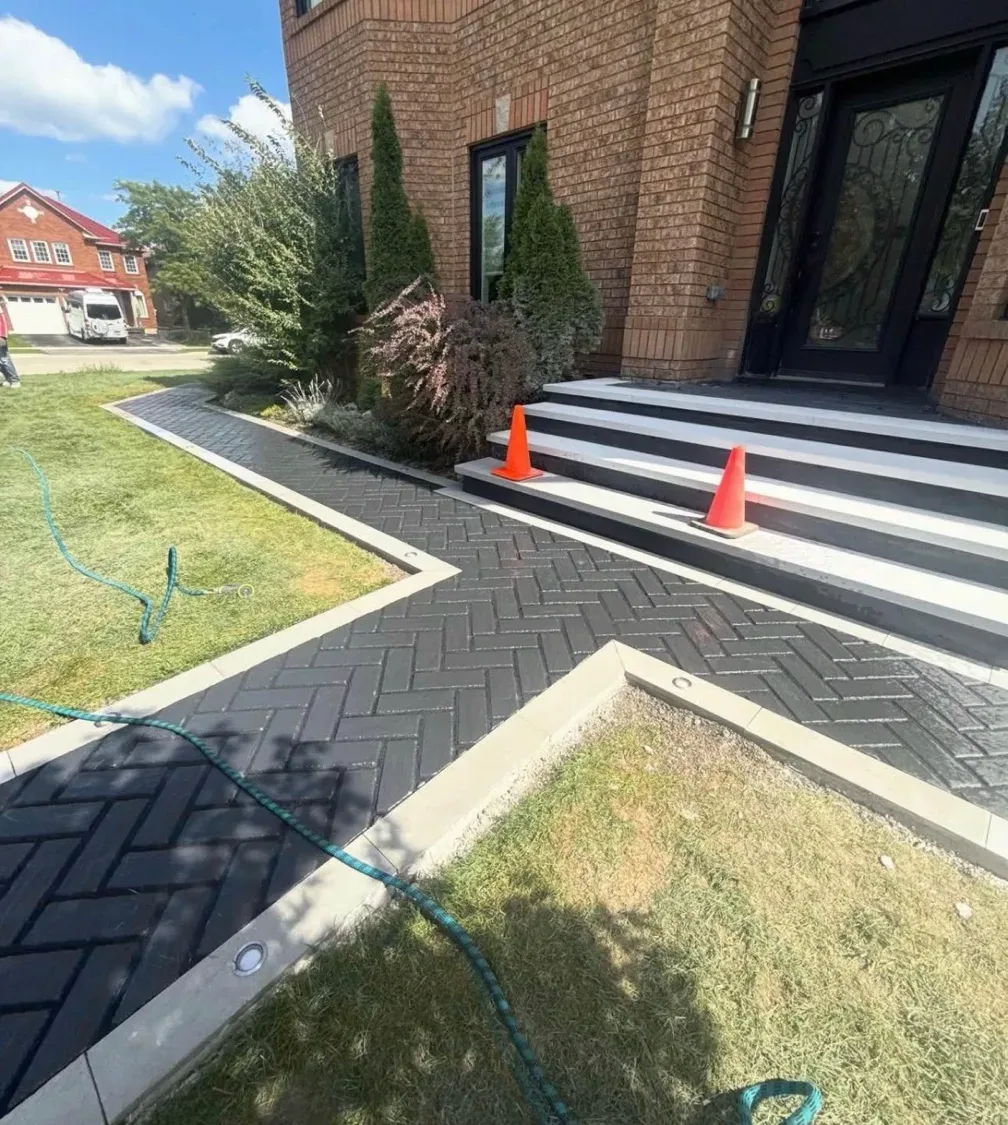
Front-entrance herringbone interlock walkway with stone-capped steps and integrated landscape borders.
Why Waterloo Region Homeowners Trust Us
Deep Base ConstructionWe never sacrifice base depth. Interlock driveways get a full 8-inch compacted granular base — the standard that prevents settling and shifting over Ontario winters.
Polymeric Sand IncludedWe finish every project with polymeric joint sand — not regular sand — to eliminate weed growth and ant tunnelling between joints from day one.
Drainage Graded CorrectlyWe pitch all interlock surfaces away from buildings and toward proper drainage outlets — preventing water from pooling or directing toward your foundation.
Wide Stone SelectionWe work with multiple Ontario suppliers and can source Unilock, Permacon, Oaks, and other premium interlock products to match your vision and budget.
Custom interlock steps with white stone caps transitioning into a charcoal herringbone driveway.
Recent Builds — Statement Patios & Front Entries
From mixed-format backyard patios to feature-lit night walkways and premium slab step entries, here's a look at what our crews are putting in the ground across Kitchener-Waterloo and the surrounding region.
Backyard patio in Kitchener — mixed-format cream pavers with charcoal accent inset and full black border. The wet finish is what every install looks like after a fresh rain.Premium 4-step slab entry — light grey treads with charcoal risers, transitioning into a full charcoal herringbone driveway. Built for a red-brick home in Waterloo.
Featured Project — Night Walkway With Backlit Steps
Our most-photographed install of the year. Large-format slate pavers with a charcoal herringbone runner down the centre, low-voltage LED step lights tucked under every riser, and in-ground uplights along the path. The whole entry transforms after dark.
Backlit step risers, in-ground uplights, charcoal herringbone runner inset into large-format slate pavers. Built and lit by D&D Exterior Finishing.
Premium Material Sourcing — Curbside on Day One
We pull from multiple Ontario quarries and authorized dealers (Unilock, Permacon, Oaks, Techo-Bloc, plus natural Algonquin and Indiana limestone slabs) — and stage everything on-site before a single piece goes in the ground. This is what your driveway looks like the morning of install day.
Pallets of large-format natural stone slabs staged curbside in a K-W neighbourhood the morning of install — premium materials sourced direct from quarry.
How much does interlock installation cost in Kitchener-Waterloo?
Interlock costs vary by square footage, stone product selected, and site conditions. D&D Exterior Finishing provides free, detailed written estimates. Contact us for an accurate quote for your specific project.
Is D&D Exterior Finishing licensed and insured for interlock?
Yes. We are fully licensed and insured for interlock installation in Ontario, WSIB compliant, and experienced in all aspects of base preparation and stone laying.
Do you offer a warranty on interlock installations?
Yes. All interlock projects include our workmanship warranty. Stone product warranties vary by manufacturer. Details are clearly stated in your written estimate.
How long does interlock last in Ontario?
A properly installed interlock surface should last 25–30 years or more. The stones themselves rarely fail — it's the base that determines longevity. Our deep granular base construction ensures the surface remains flat and stable through decades of Ontario freeze-thaw cycles.
Do you serve my area for interlock?
We install interlock in Kitchener, Waterloo, Cambridge, Guelph, Elmira, Ayr, New Hamburg, Baden, Woodstock, Brantford, Breslau, and surrounding communities.
Is interlock or concrete better for driveways in Ontario?
Both are excellent choices, and each has advantages. Concrete is slightly more affordable upfront and provides a seamless surface. Interlock is easier to repair (individual stones can be replaced), handles freeze-thaw movement better due to the flexible jointed surface, and offers much more design flexibility. For driveways where aesthetics and repairability are important, interlock is typically the preferred choice in Waterloo Region.
How do I maintain my interlock after installation?
Newly installed interlock requires very little maintenance. We recommend: sweeping polymeric sand back into joints annually, applying a quality sealer every 3–5 years to protect colour and lock joints, and promptly replacing any sand disturbed by heavy rain or snowblower use. We can advise on specific maintenance products at project completion.
Service Areas for Interlock
We install interlock throughout Waterloo Region: Kitchener, Waterloo, Cambridge, Guelph, Elmira, Fergus, Elora, Ayr, New Hamburg, Baden, Woodstock, Brantford, Breslau, St. Jacobs, and more.
Leading brands in exterior building products
Tyvek
CertainTeed
LP SmartSide
Westlake Royal
GAF
IKO
Owens Corning
Discuss Interlock Work
Review the scope above, then send your property and service details.