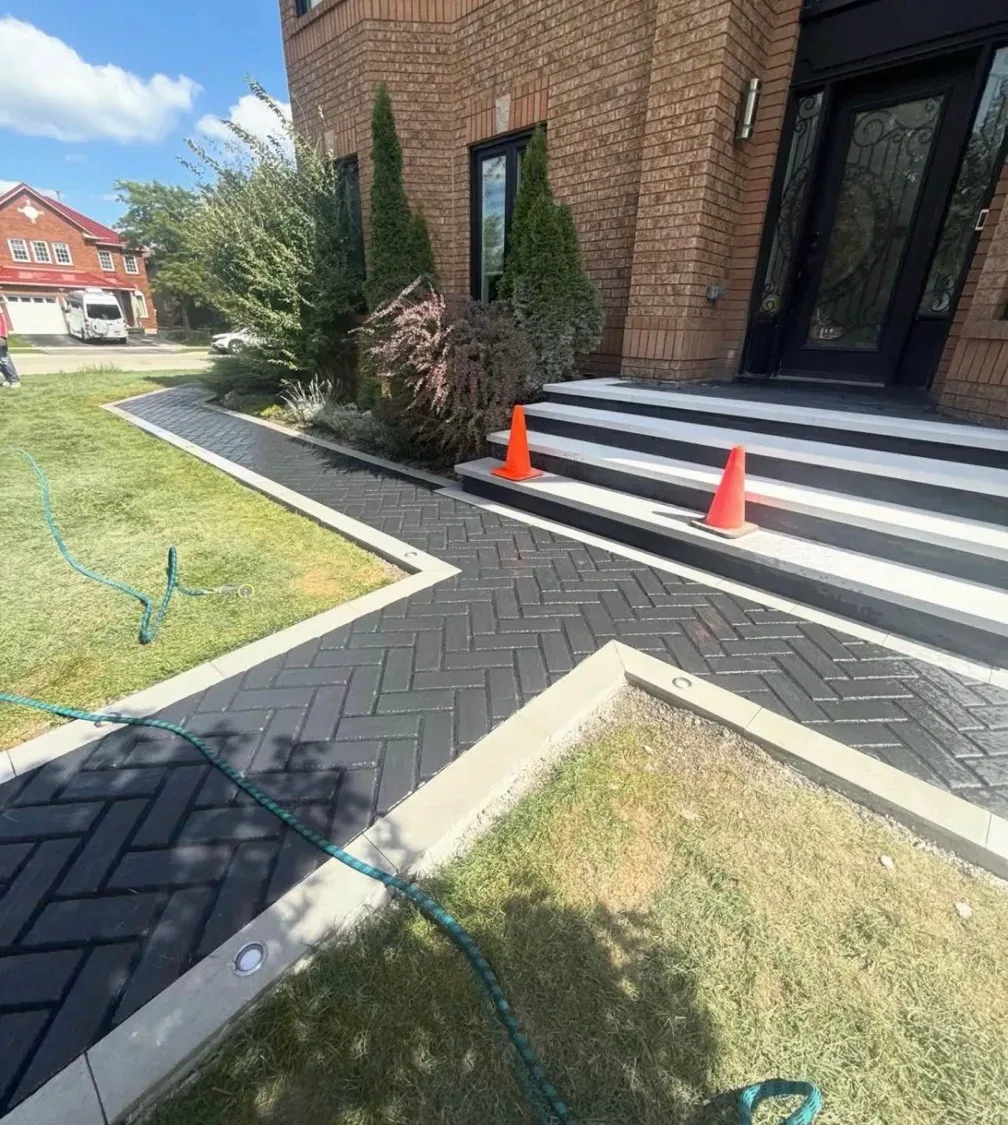
















Interlock and paver work in Fergus & Elora
D&D Exterior Finishing installs interlock in Fergus and Elora: driveways, patios, walkways, steps and poolside areas in concrete pavers or natural stone. The crew excavates, builds a compacted granular base in layers, sets the bedding and edge restraint, and sweeps polymeric sand into the joints. A free written estimate comes first. Slopes are set so water runs off.
Fergus and Elora pair old streets with new ones, and a paved surface has to handle both. Winter salt, spring melt and months of freeze and thaw shift poorly built bases. Well-laid pavers also suit both a heritage-style entry and a newer driveway because the look comes from the stone pattern, not the age of the house.
What decides whether interlock lasts here
The base underneath
Interlock driveways need a deeper base than patios and walkways, typically about 20 to 30 cm, compacted in layers. Skimping there is why pavers sink. Geotextile goes down where the soil calls for it, especially where clay or soft ground holds water.
Falls away from the house
Surfaces are sloped to move water away from the foundation, which matters on lots near the river and on lots with a wet spring. Permeable pavers are an option, letting water soak through joints into an open-graded base.
Repairing tired paving
Sunken or heaved pavers, weeds and ants in the joints, and edges that creep outward are common complaints on older installs. Many repairs are done by lifting and relaying the pavers on a corrected base, rather than starting over.
Interlock cost depends on the area, base depth, paver type, pattern, edge details, excavation and drainage. Driveways need a deeper base than patios, which affects the total. The free written estimate shows it all.
Interlock questions from Fergus & Elora homeowners
Do you install interlock driveways in Fergus?
Yes. D&D handles driveways, patios and walkways in Fergus and Elora. Call (519) 501-5003, describe the area, and the estimate will outline base depth, pavers and edging.
Can sunken pavers be fixed without replacing them?
Often. The pavers are lifted, the base is corrected, and the same pavers are relaid. This depends on their condition, so the crew looks at the area before quoting.
How is interlock kept from shifting?
A compacted granular base, edge restraint around the perimeter and polymeric sand in the joints lock the pavers together, helping them stand up to freeze and thaw.
What are permeable pavers?
They have joints that let water soak through to an open-graded base below. They suit sites where runoff is a concern and are one of the choices we can price.