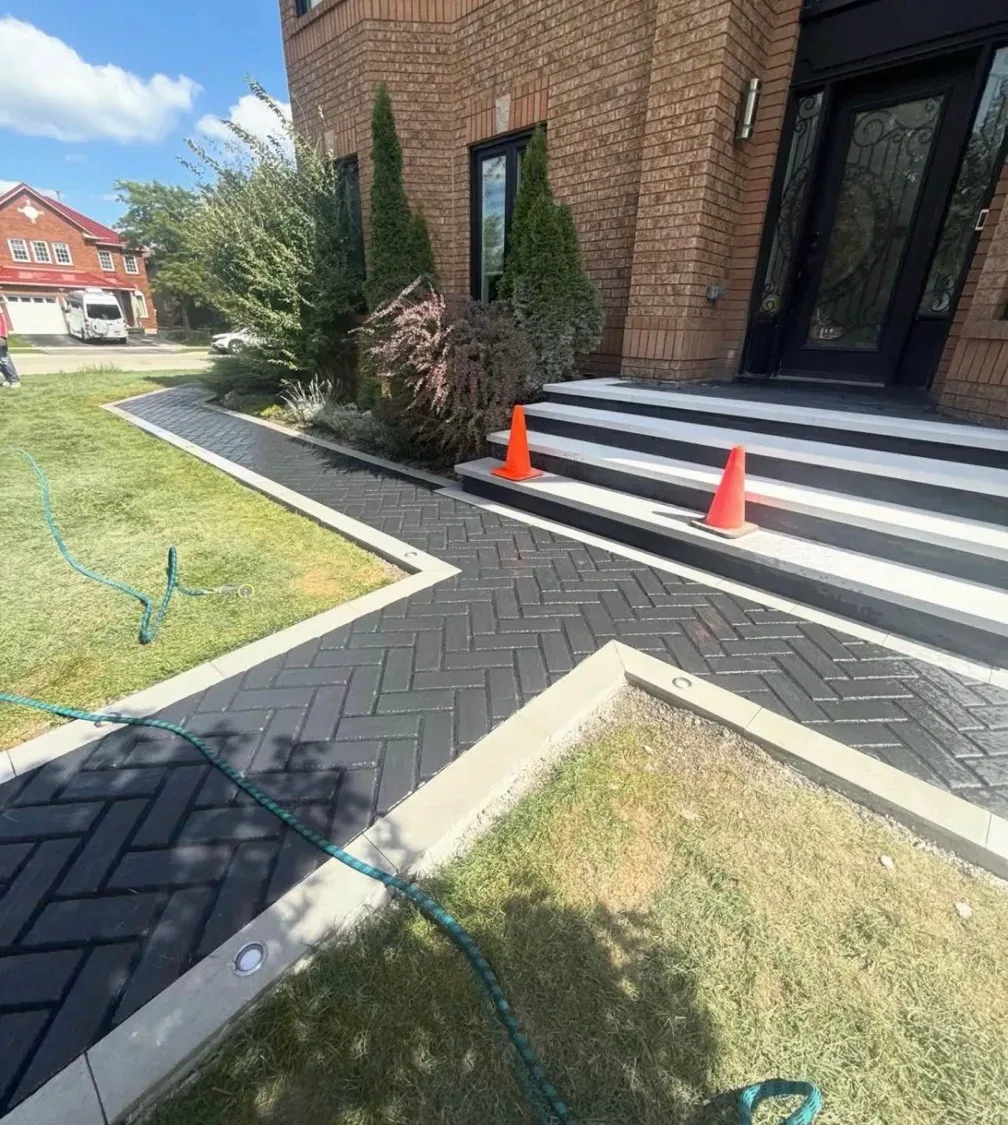


















Interlock driveways, patios and stone work in Guelph
D&D Exterior Finishing handles interlock installation in Guelph, covering driveways, patios, walkways, steps and poolside areas in concrete pavers or natural stone. Our work reaches Downtown Guelph, Old University, Exhibition Park, Kortright Hills and the South End, and repairs on sunken or heaved pavers are part of the service. A free written estimate comes first. Interlocking stone in Guelph means pavers or natural stone on a compacted base, so the surface stays level through freeze-thaw winters.
John Galt laid out Guelph in 1827 on a radial and grid street plan, which left blocks and lots in a mix of sizes and shapes that is still visible. The Old City Hall of 1856 was built of Guelph stone, and the limestone Goldie Mill still stands in part beside the Speed River. That stone tradition makes natural stone a fitting choice, though any surface lasts only as long as its base.
Interlock work for Guelph homes and heritage streets
Interlocking stone and natural stone
Natural stone can give a Guelph entrance the feel of the city's older buildings. It goes down on the same compacted base as concrete pavers, with a bedding layer, edge restraint and tight, even joints. We go through stone options, colours and patterns during the estimate.
Layouts for odd-shaped and angled lots
Lots that do not meet at right angles mean more cutting and more care at the borders. We plan the pattern so the cuts land in sensible places and the edges meet lawns, steps and foundations cleanly, with the slope set to carry water away from the house.
Driveways with a deep, layered base
The base is what a driveway really is. We excavate, lay geotextile where needed, and compact granular base in layers, typically about 20 to 30 cm (8 to 12 inches), before the bedding layer and pavers go on. That depth carries vehicles through winter.
Interlock repair for settled or tilted pavers
When a patch of pavers has dropped, the pavers are rarely the cause. We lift the area, correct the base and relay the surface so it sits level with its neighbours. Joints are then filled with polymeric sand to lock everything in place.
Getting ready for interlock work in Guelph
Rough measurements of the area, plus where it meets the house, garage and fences, give a clearer first conversation. We confirm everything on site at the estimate.
Door sills, stoops and foundation edges set the finished height. Tell us about thresholds and garage doors so the surface lines up and water has a path away.
If you have sunken pavers now, write down where they dip and when. Dips after spring melt point to base or drainage trouble, which we correct before relaying.
Tree roots can lift edges, and shade keeps joints damp. Show us where trees stand so the layout and the edge restraint can allow for them.
The final number for a Guelph interlock project comes from the area, the depth of excavation and base, the paver or stone selected, the pattern and borders, and any repairs underneath. Your estimate is free and in writing.
Guelph homeowners ask us about interlock
What does interlock installation cost in Guelph?
It depends on the surface area, how much digging and base are needed, the pavers or stone you choose, the pattern and borders, and the removal of what is there now. We measure on site and give a free written estimate that lists each part.
Do you work with natural stone as well as concrete pavers?
Yes. Both are options for driveways, interlock patios, walkways and steps. Natural stone has a varied look that suits older homes, while concrete pavers offer many colours and patterns. We lay both on a properly built base.
Why are some of my pavers sinking?
Sunken pavers usually mean the base underneath has shifted, was not compacted well or is losing support to water. Fixing the pavers alone will not last. We lift them, rebuild the base and relay the same stones where possible.
Can permeable pavers work on a Guelph property?
They can. Permeable pavers let water pass through the joints into an open-graded base, which helps when runoff is a problem. We look at your lot during the estimate and tell you whether they make sense.
How do I keep weeds out of the joints?
Polymeric sand sets firm and makes it harder for weeds and ants to move in. If the joints are already overrun, we clean them out and re-sand. If pavers have moved as well, we relay them first.