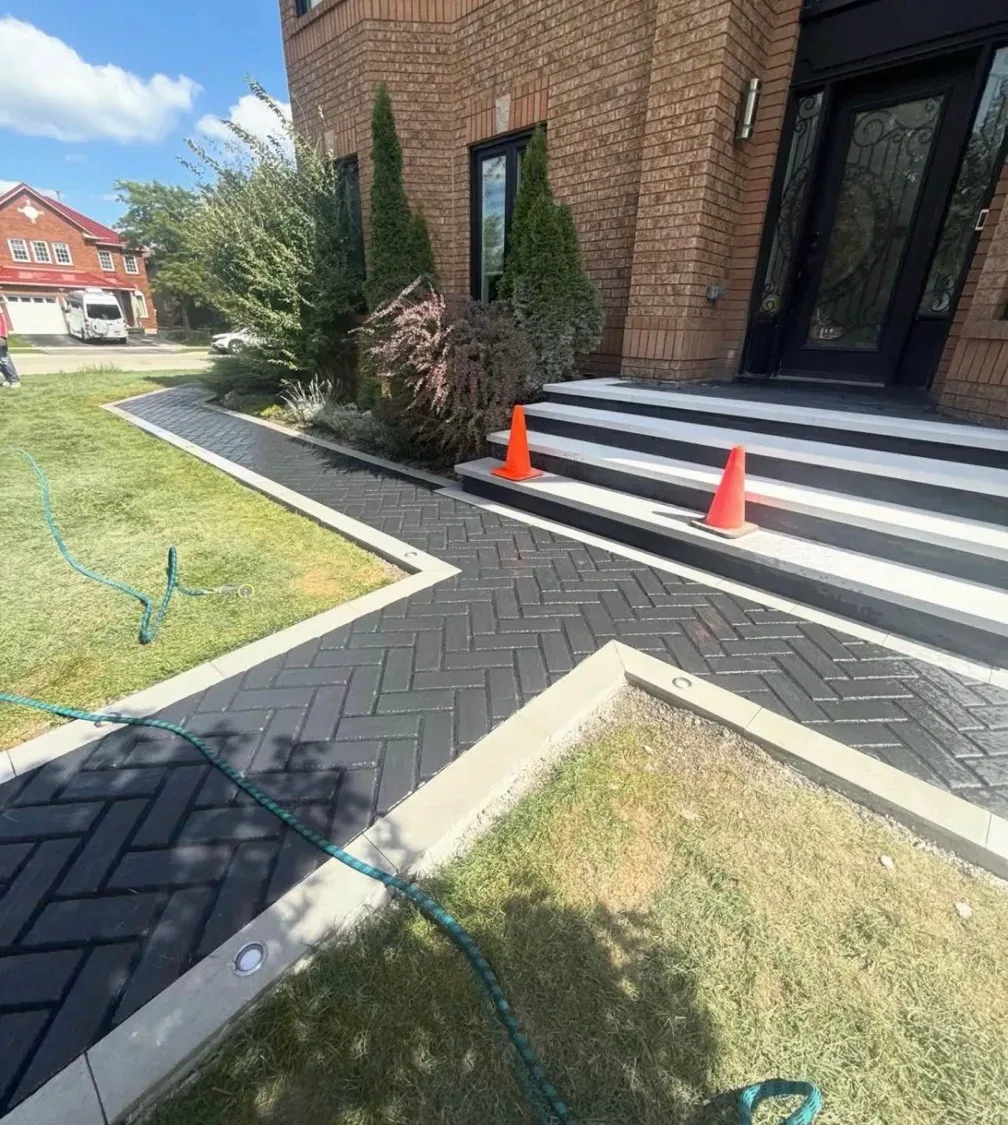


















Interlock work in Acton
D&D Exterior Finishing installs interlock driveways, patios, walkways, steps and poolside areas in Acton, in concrete pavers or natural stone. The base is excavated and compacted in layers, then bedded, edged and finished with polymeric sand. The free written estimate lists the area, base depth and paver choice. Steps and poolside areas are laid to the same standard.
Acton's yards have seen a lot of change. Land beside Fairy Lake, the Crescent subdivision and farmland later turned into Glenlea and Lakeview all came into town between 1918 and 1955. Soil and drainage differ from lot to lot, and de-icing salt and freeze-thaw cycles test any hard surface through the colder months.
What drives interlock jobs here
Base depth
A driveway needs a deeper base than a walkway or patio, typically about 20 to 30 cm (8 to 12 inches) of compacted granular material. Geotextile goes in where the soil is soft. Shortcuts here show up later as sunken wheel tracks.
Drainage and slope
Water has to leave the house, so every surface is graded away from the foundation. Yards near the lake or creek hold moisture longer. Permeable pavers, which let water pass through the joints into an open-graded base, can suit those spots.
Repairing tired pavers
Sunken or heaved pavers, weeds, ant hills and spreading edges are common in older installations. Many are fixed by lifting the pavers, correcting the base and laying them again, which saves replacing the whole surface. Edge restraints are checked and renewed where they have crept outward, and polymeric sand is topped up.
Interlock is priced by area, base depth, excavation, paver or stone type, edging, and patterns or steps. A driveway needs more base than a patio. The free written estimate shows each item.
Interlock questions from Acton homeowners
How deep should an interlock driveway base be?
Typically about 20 to 30 cm (8 to 12 inches) of compacted granular base, laid in layers. Patios and walkways need less. A thinner driveway base tends to settle under vehicle weight.
Can my sunken interlock be fixed?
Often, yes. The pavers are lifted, the base is corrected and re-compacted, then the same pavers are relaid. Edges that have spread can be restrained at the same time.
What is polymeric sand for?
It is swept into the joints and hardens slightly when wet. It locks pavers together and discourages weeds and ants. It may need topping up over the years.
Are permeable pavers an option in Acton?
Yes. Permeable pavers let water soak through the joints into an open-graded base, which can help where drainage is a concern. We say whether your lot suits them.