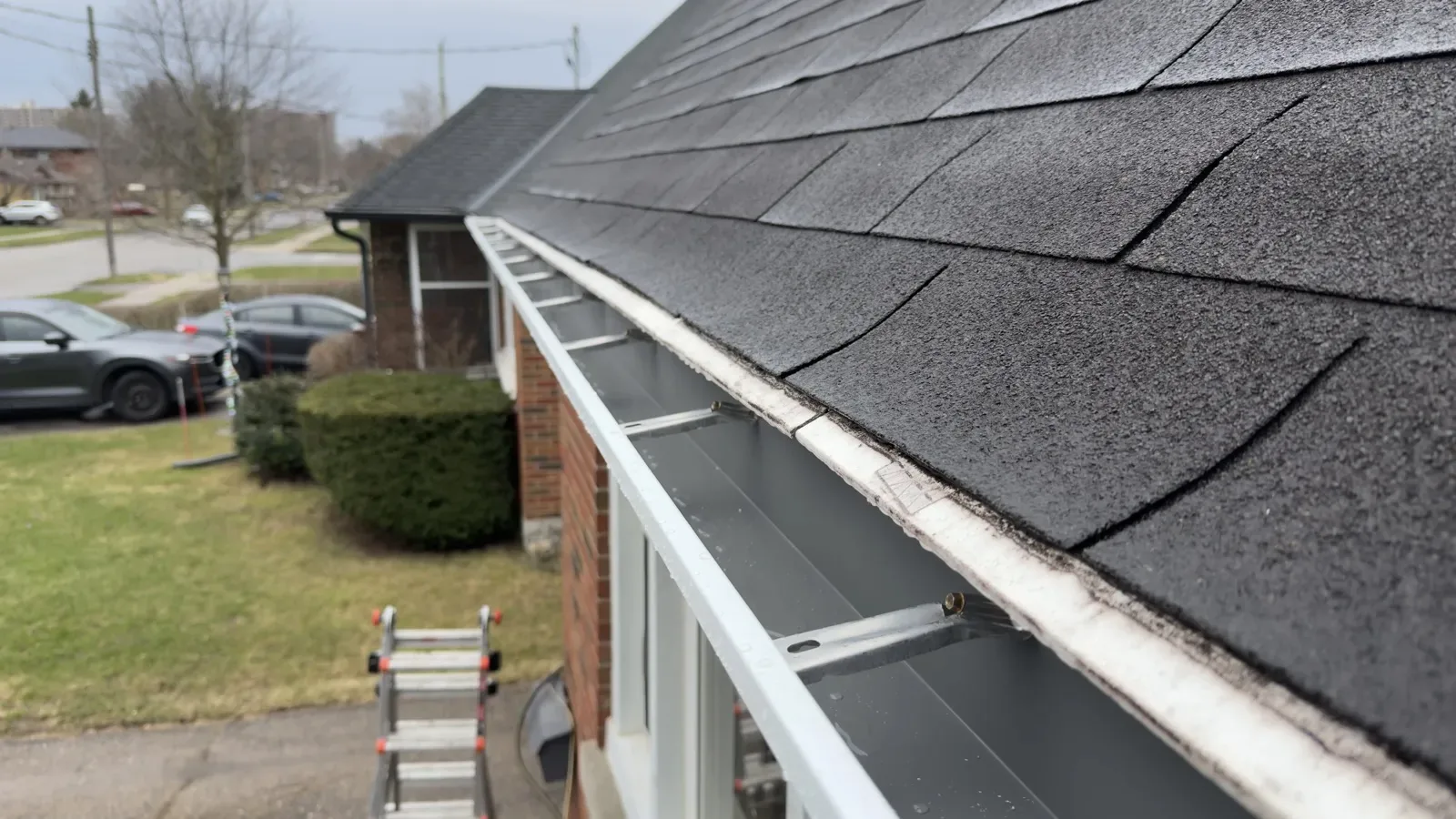
Confirm suitable backing and support
The installer should assess the attachment area and address failed fascia or backing before hanging the new gutter. Ask what the fasteners engage and which hanger product is specified. Reusing a hole in damaged material does not establish a secure connection.
Hanger spacing and fasteners should follow the selected system and its conditions of use. A universal 60–90 cm spacing range or a rule that nails are always unacceptable is not a substitute for the manufacturer’s detail. Record the actual specification in the scope.
Check the fall and remaining joints
Each run needs its planned route to an outlet. As one product-specific example, Gentek’s standard five-inch guide specifies a minimum fall of 6 mm over 3 m toward the nearest outlet. Have the installer verify the requirements for the product being installed.
Continuous, machine-formed runs reduce intermediate seams; they do not remove end caps, corners, outlets or all movement considerations. Inspect those details and the sealant/connection method specified for them. A coating of sealant over an unresolved gap is not evidence that the joint is sound.
Verify outlet performance and handover
Ask how gutter and downspout sizes relate to the contributing roof areas. Confirm that outlet holes, elbows and downstream connections do not restrict the planned flow and that the discharge respects the property’s drainage arrangement.
Request completion photographs, product details and care instructions. A controlled water check can reveal obvious leaks or low spots, but is not proof of performance in every storm. Record what was checked and arrange review of any remaining overflow after the system is clear.
Technical references
- Gentek aluminum soffit, fascia and rainware installation guide — Standard five-inch guide: support, joints and minimum 6 mm per 3 m drainage fall.
- Government of Canada: Eavestroughs and downspouts — Outlet and discharge maintenance remains necessary.

Include a preferred date and time
Discuss your exterior project
Select the exterior work and note the current material and repair or replacement needs.
Prefer to send the details first? Request a quote or call (519) 501-5003.